
On this page
- Key Takeaways
- What Is the Vinegar Bag Method?
- Why Does Vinegar Dissolve Shower Head Scale?
- How to Clean Shower Head With Vinegar Bag?
- How Long Should You Soak the Bag On?
- Which Finishes Should Skip a Long Vinegar Soak?
- What If Nozzles Stay Clogged After Soaking?
- How Often Should You Descale a Shower Head?
- When the Bag Method Is the Wrong Tool
- Frequently Asked Questions
- Conclusion
- Sources
Last updated: October 26, 2026
This My Homesblogs guide shows how to clean shower head with vinegar bag without removing the fixture. Fill a bag with equal parts white vinegar and warm water, tie it over the head so every nozzle stays submerged, soak, then flush with hot water for an even spray.
Key Takeaways
- Limescale is calcium carbonate; vinegar’s acid turns it into a soluble salt that rinses away.
- A bag tied over a fixed head matches a removal soak.
- Coated finishes need a short soak or a different cleaner, or the coating dulls.
- A nozzle that stays blocked after soaking points to the filter screen or a worn washer.
What Is the Vinegar Bag Method?
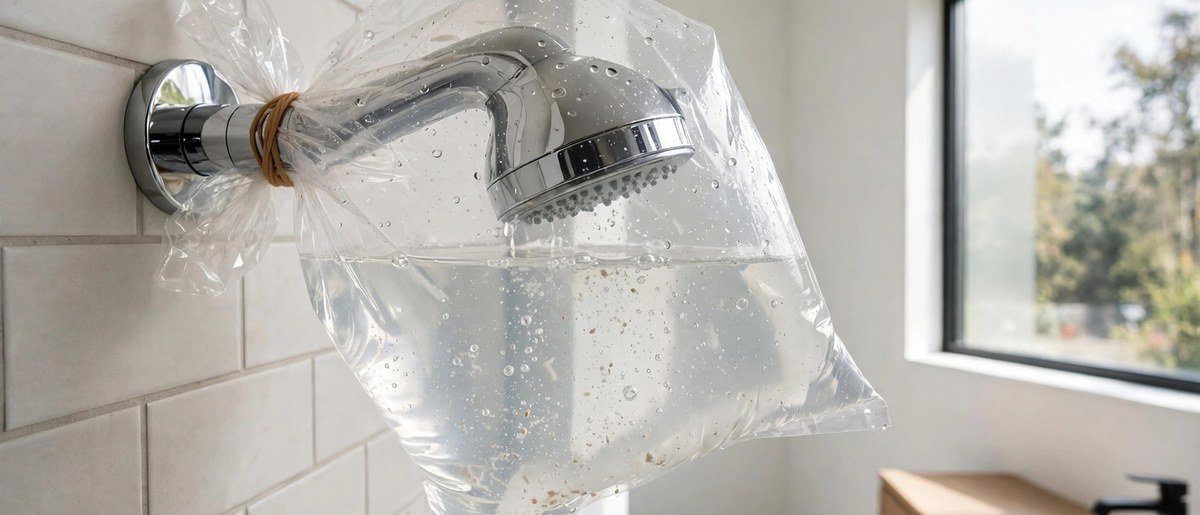
The vinegar bag method is a way to descale a shower head without removing it: a plastic bag filled with a vinegar solution is tied over the head so the nozzle face stays submerged while the acid dissolves scale.
Why Does Vinegar Dissolve Shower Head Scale?
Vinegar dissolves shower head scale because its acid converts calcium carbonate into a water-soluble salt that rinses away. Hard water carries dissolved calcium and magnesium; droplets drying on the nozzle face leave a crust that narrows each hole and bends the spray.
Bob Vila’s 2026 shower head guide puts vinegar’s pH near 2, far into the acidic range. That strength is why the soak does the work: acid loosens the crust from inside each hole, so a soft brush finishes a job dry scrubbing cannot start — and that is how a vinegar soak can descale shower head nozzles a dry brush only polishes.
How to Clean Shower Head With Vinegar Bag?
You can clean shower head without removing it from the arm. Gather a sturdy bag, white distilled vinegar, warm water, two rubber bands, a toothbrush, and a toothpick.
- Mix equal parts white distilled vinegar and warm water, about 1 to 2 cups each.
- Pour the mix into the bag and slide it over the head until every nozzle is submerged.
- Squeeze air from the bag top and fasten it to the arm with two rubber bands, one above the joint and one below, so its weight cannot drag it down.
- If the bag hangs heavy, pour a little mix back out; only the nozzle face needs to stay submerged.
- Leave the bag on for the soak time in the timing guide below, then thumb-rub one nozzle to check.
- Remove the bag and run the shower hot for 2 to 3 minutes to flush loosened scale out.
- Scrub the nozzle face, thumb-press each silicone nozzle under running water, and ease the toothpick into holes still spraying sideways. Never use a metal pin on rubber; it tears silicone.
- Dry the head and re-run the shower to check the spray.
Before the soak, blocked holes throw thin, bent jets; after a good soak and flush, they run straight and even.
How Long Should You Soak the Bag On?
Match the soak to the buildup and the finish: light scale clears fast, heavy crust needs longer. Delta’s shower head cleaning guide sets a 30-minute soak in a vinegar-water mix, followed by a rub and a rinse. Use that as the baseline for a head that still sprays well: check at 30 minutes, and extend only when nozzles still feel rough.
Soak-time figures at a glance:
| Situation | Figure | Source |
|---|---|---|
| Heavy scale, chrome or stainless steel | Overnight soak, 8 hours or more | Engineer Fix |
| Delicate plated finishes | 1 hour maximum | Engineer Fix |
| Showerhead biofilm, M. avium vs incoming water | About 100 times higher | University of Colorado Boulder |
| Chrome plating, bag soak ceiling | No longer than 4 hours | StoneStream |
Which Finishes Should Skip a Long Vinegar Soak?
Chrome, stainless steel, and plain plastic tolerate vinegar; coated finishes do not. Moen’s finish care guidance says to skip a vinegar soak entirely on matte black and gold finishes. On those heads, clean with warm water and mild dish soap, and keep vinegar off the surface even as a quick wipe.
Nickel, brass, and oil-rubbed bronze sit in the middle: a brief diluted soak plus an immediate full rinse is the safe ceiling, and a test spot on a hidden edge settles doubt first. A finish that already looks patchy or dull will not heal with another soak; that damage is cosmetic, and the fix is a replacement head, not more acid.
What If Nozzles Stay Clogged After Soaking?
A nozzle that stays blocked after a full soak has a problem vinegar cannot dissolve. Unscrew the head, pull the shower head filter screen from the inlet with pliers, and rinse it while brushing with a toothbrush; a grit-matted screen chokes flow no matter how clean the nozzles look.
For clogged shower head nozzles that survive the soak, ease a wooden toothpick into each hole and flush again; a metal pin tears silicone, so wood is the right tool. Check the washer too; a swollen washer leaks pressure and mimics a clog. If the job grows while you are at it — say a rotted wooden shower bench needs new boards — run the board sizes through a BD FT Calculator before buying lumber so you pay for only the wood you need.
If flow stays weak after the screen, washer, and nozzles are clean, the restriction sits in the arm, valve, or supply, and that is a plumber’s job; a new head will not fix a supply problem.
How Often Should You Descale a Shower Head?
Set the schedule by your water: hard water builds scale fast, soft water barely builds any. The U.S. Geological Survey classes water above 120 milligrams per liter as hard. In a hard-water home, soak every 1 to 3 months; in a soft-water home, twice a year is plenty.
For more bathroom cleaning routines, browse homesblogs before your next deep clean. Between soaks, thumb-rub the nozzles under running water monthly; that habit pops fresh deposits out before they harden. That rhythm is the whole secret of shower head limescale removal: short, regular soaks beat one long rescue soak.
When the Bag Method Is the Wrong Tool
Vinegar drips etch natural stone, so keep the bag away from marble, limestone, and travertine, and wipe splashes at once. A ceiling-mounted rain head that cannot hold a bag’s weight should come off the arm for a bowl soak; a cracked head needs replacement, not descaling.
Frequently Asked Questions
Can you clean a shower head with a vinegar bag without removing it?
Yes. The bag ties over the fixed head and holds vinegar against the nozzles. A head that unscrews easily can go in a bowl instead.
How long do you leave a vinegar bag on a shower head?
Match the time to the buildup and the finish, using the timing guide above. Light scale clears fast; heavy crust takes longer; coated finishes get the shortest time.
Does vinegar damage a shower head?
No, not chrome, stainless steel, or plain plastic when you rinse fully afterward. Coated finishes are the exception: matte black and gold should skip vinegar, and myhomesblogs recommends dish soap and water instead.
What ratio of vinegar to water should go in the bag?
Equal parts white distilled vinegar and warm water, enough to cover the nozzle face. Stronger vinegar is unnecessary; undiluted vinegar buys nothing the equal-parts mix cannot do.
Why is my shower head still clogged after vinegar?
The blockage sits past the nozzles, usually in the filter screen or a worn washer. Clean the screen, check the washer, flush again; weak flow after that means the arm or supply.
Can I use apple cider vinegar instead of white vinegar?
White distilled vinegar is the better choice. Cider vinegar can tint light finishes; save it for cooking and keep distilled vinegar for the shower head.
Conclusion
Once you learn how to clean shower head with vinegar bag, the whole job takes under an hour of hands-on time: mix, tie, soak, flush. Keep the rhythm — a short soak every few months — and the spray stays straight and even for years.
Sources
- Bob Vila — How to Clean a Shower Head (2026)
- Delta Faucet — How to Clean a Shower Head
- Moen — shower head finish care guidance (summarized by Sensible Digs)
- U.S. Geological Survey — water hardness scale
- University of Colorado Boulder — showerhead biofilm study
- Engineer Fix — How Long Should You Soak a Shower Head in Vinegar?
- StoneStream — How to Clear a Clogged Shower Head



Leave a Reply