
On this page
- Key Takeaways
- What Is Bathroom Ceiling Mold?
- Why Does Mold Grow on a Bathroom Ceiling?
- Is Bathroom Ceiling Mold Dangerous?
- Can You Remove Bathroom Ceiling Mold Yourself?
- How to Get Rid of Mold in Bathroom Ceiling Step by Step?
- How Do You Stop Bathroom Ceiling Mold From Coming Back?
- When the Usual Cleanup Does Not Apply
- Frequently Asked Questions
- Conclusion
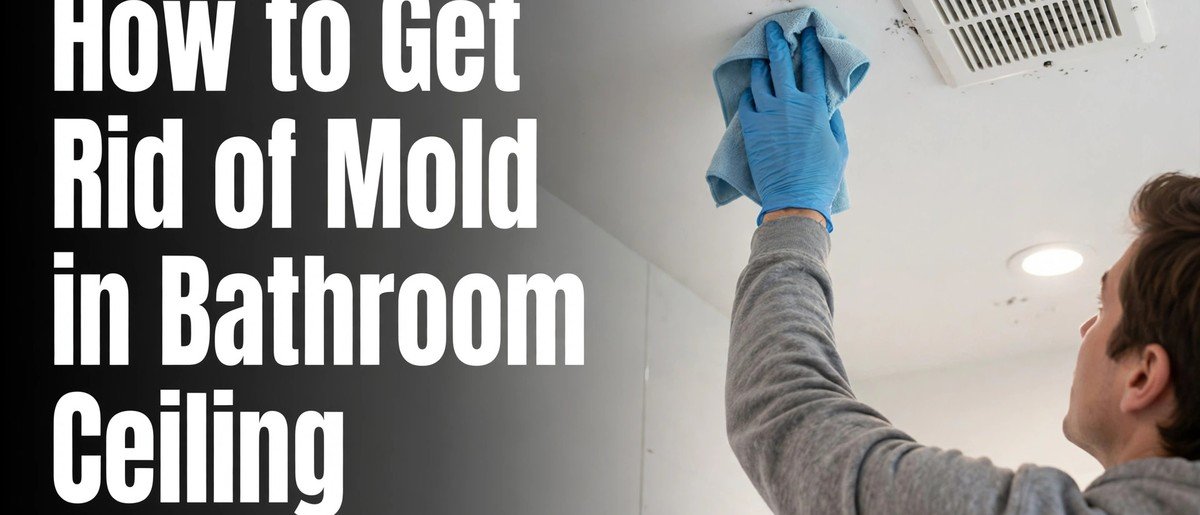
To learn how to get rid of mold in bathroom ceiling safely, fix the moisture source first, then scrub the patch with detergent and water and dry it completely. This My Homesblogs guide gives the full sequence: measure, protect, clean, dry, and repaint safely.
Key Takeaways
- Ceiling mold feeds on moisture, so cleaning without fixing the water source only buys a few weeks.
- A small surface patch is a DIY job; a large patch or sagging drywall belongs with a professional.
- Detergent and water, not bleach, do the real cleaning work on ceilings.
- Never paint over mold: paint seals the growth in and the stain bleeds back through.
- Run the exhaust fan during and after every shower, and keep indoor humidity low.
What Is Bathroom Ceiling Mold?
Bathroom ceiling mold is fungal growth feeding on moisture, dust, and ceiling drywall’s paper facing.
Warm, damp air rises after every shower and condenses on the cooler ceiling surface, feeding the growth. Mildew is the flat, powdery form that wipes off easily; true mold grows fuzzy or raised patches and roots into porous material. Dark patches are often called black mold on bathroom ceiling searches, but color alone never identifies the species.
Why Does Mold Grow on a Bathroom Ceiling?
Warm air rises, so the bathroom ceiling is the coolest surface in the room after a hot shower.
Steam condenses there first, and without strong ventilation the surface stays damp for hours. A second cause hides above the ceiling: a roof leak, a sweating pipe, or a fan duct that dumps into the attic instead of outside. Insulation gaps also chill one ceiling section, so condensation concentrates there.
The U.S. Environmental Protection Agency’s mold guidance, updated in September 2026, states that damp materials dried within 24 to 48 hours usually do not grow mold — so find the wet source fast and dry the ceiling fast.
Is Bathroom Ceiling Mold Dangerous?
Mold on a ceiling is a cleanup priority, not a reason to panic.
The U.S. Centers for Disease Control and Prevention lists symptoms in sensitive people: a stuffy nose, sore throat, coughing or wheezing, burning eyes, and skin rash. That list explains the protection and the closed room during scrubbing: scrubbing launches spores into the air, and exposure peaks during the work. A patch that keeps returning deserves a moisture investigation, not another round of scrubbing.
Can You Remove Bathroom Ceiling Mold Yourself?
Measure the patch first, because size decides who does the job.
A small patch of mold on bathroom ceiling paint, with no sagging, no soft spots, and a known, fixed moisture source, is a DIY cleanup. A patch spanning several panels, growth around a vent or light fixture, a sagging ceiling, or a musty smell with no visible patch all point past DIY: the growth is bigger than the visible stain, or it lives inside the ceiling. The table below gives the exact decision lines.
| Decision line | Figure | Source |
|---|---|---|
| DIY-size patch | Under about 10 sq ft (about 3 ft by 3 ft) | U.S. Environmental Protection Agency |
| Indoor humidity target | Below 60%, ideally 30–50% | U.S. Environmental Protection Agency |
| Bleach dilution cap, if bleach is used at all | No more than 1 cup per gallon of water | U.S. Centers for Disease Control and Prevention |
| N-95 respirator filtration | 95% of airborne particles | U.S. Environmental Protection Agency |
| Fan sizing above 100 sq ft | 50 CFM per toilet, shower, or tub; 100 CFM for a jetted tub | Home Ventilating Institute |
| Dead mold after treatment | Still allergenic; removal matters more than killing | U.S. Environmental Protection Agency |
How to Get Rid of Mold in Bathroom Ceiling Step by Step?
Work top down in one session: protect, clean, dry, and check before repainting.
No special ceiling mold cleaner is required; detergent and water do the work.
- Measure the patch and look above it for a leak, wet insulation, or a fan duct ending in the attic, and fix that source before scrubbing.
- Gear up first: fitted N-95 respirator, non-latex gloves, and sealed goggles with no vent holes. Open a window, switch the exhaust fan on, and keep children and pets out until the room is clean and dry.
- Protect what sits below: a drop cloth over the tub and floor, and a closed bathroom door to keep spores out of the house.
- Mist the patch lightly with water. A damp surface releases fewer spores during scrubbing than a dry, dusty one.
- Scrub with detergent and water: non-ammonia detergent, a stiff brush for flat paint, an old toothbrush for texture and corners. Wipe with a damp cloth; never flood the ceiling.
- Rinse and dry completely: wipe again with a clean damp cloth, then run fans or a dehumidifier until the ceiling feels dry and stays dry overnight.
- Bag the waste and wash up: seal used cloths and the drop cloth in a plastic bag, then wash hands and forearms and launder work clothes in hot water.
- Inspect before repainting: firm, flat drywall takes primer, while soft, sagging, or crumbling drywall needs cutting out and replacement — a professional job.
The mistake that wastes the whole job is painting over the stain: paint seals live growth under a fresh coat, and the stain bleeds back within weeks. Primer goes on only after the surface is clean and fully dry.
How Do You Stop Bathroom Ceiling Mold From Coming Back?
Fixing the moisture source beats every cleaner on the shelf.
Run the exhaust fan during every shower and until the mirror clears afterward, and size the fan to the room: the Home Ventilating Institute recommends 1 CFM of exhaust per square foot of floor for bathrooms up to 100 square feet, with 50 CFM as the minimum. Example: an 8-by-10-foot bathroom (80 square feet) needs 80 CFM; a 5-by-8-foot room (40 square feet) takes the 50 CFM minimum. Check where the duct ends: a fan venting into the attic dumps every shower’s steam above the ceiling, and rerouting it outside removes the moisture.
The cheapest way to prevent bathroom ceiling mold: a fan that runs every shower, a duct that ends outside, and a ceiling that dries between showers.
For more bathroom moisture guides, browse homesblogs before your next repaint.
Repaint only a clean, fully dry ceiling: mold-resistant primer, then a bathroom-rated topcoat, with the primer step after cleaning, never instead of it. If the repair grows while you work — say a sagging section needs a new wooden brace — run the brace dimensions through a BD FT Calculator before buying lumber so you pay for the wood you need and nothing more.
When the Usual Cleanup Does Not Apply
Some ceiling mold sits beyond DIY no matter how small the visible patch.
Mold inside the drywall, above the ceiling, or inside the ductwork cannot be scrubbed from below, and cutting into a ceiling releases a concentrated burst of spores. The same limit applies when the ceiling sags, when stains keep spreading after the leak was supposedly fixed, when the growth follows sewage backup, or when health concerns make DIY exposure unwise. In each case, stop, keep the room closed and dry, and bring in a remediation professional with containment equipment. Bathroom ceiling mold removal stops being a weekend job once the growth hides where a brush cannot reach.
Frequently Asked Questions
Can you paint over mold on a bathroom ceiling?
No. Paint seals live growth under a fresh coat, and the stain bleeds back within weeks. Clean, dry, then prime and paint.
Does bleach kill mold on a bathroom ceiling?
Bleach kills surface growth on hard, non-porous material, but fails on porous ceiling drywall, where the roots sit below the surface. Detergent and water scrub the growth off instead, and bleach must never mix with vinegar or ammonia.
How do you tell ceiling mold from mildew?
Mildew stays flat and powdery and wipes off easily. Mold grows fuzzy or raised, roots into porous material, and returns quickly after a surface wipe.
What if the mold comes back after cleaning?
The moisture source is still active. Recheck the fan, the duct route, and the space above the ceiling, and myhomesblogs recommends fixing that source before scrubbing a second time.
Should you run the bathroom fan after every shower?
Yes — during every shower and until the mirror clears afterward. That habit removes steam before it condenses on the ceiling.
Conclusion
The routine that works for how to get rid of mold in bathroom ceiling is simple: stop the water, scrub the growth off, dry the ceiling completely, and repaint only a clean, dry surface. A ceiling that stays dry stays clean.


Leave a Reply